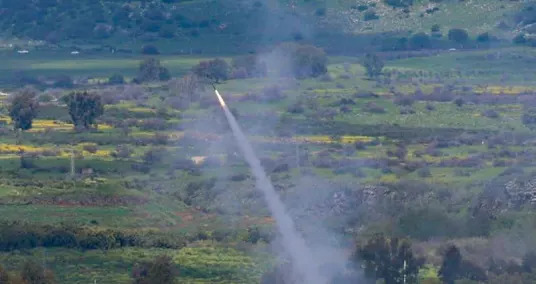
Stockpile concerns push the defense establishment to rely on less advanced systems, with mixed results.
Israel has begun limiting its use of its most advanced missile interceptors as ongoing Iranian barrages strain stockpiles, forcing the military to increasingly rely on upgraded but less capable systems, according to a Wall Street Journal report published Friday.
The shift comes as the war enters its fourth week, with Iran continuing near-daily launches of ballistic missiles and drones. In recent days, two Iranian missiles struck the southern cities of Dimona and Arad after interception attempts using modified, lower-tier systems failed.
Israeli air defenses, long regarded as among the most sophisticated in the world, have until now leaned heavily on the Arrow system to counter long-range ballistic threats. However, officials are now conserving these high-end interceptors, turning instead to enhanced versions of David’s Sling and even Iron Dome for threats they were not originally designed to handle.
The move reflects mounting pressure on military inventories, as both Israel and its allies contend with the high cost and slow production pace of advanced interceptors compared to Iran’s mass-produced missiles and drones.

Military planners must weigh each incoming threat carefully
“The number of interceptors of every type is finite,” Tal Inbar of the Missile Defense Advocacy Alliance said, noting that prolonged conflict forces increasingly difficult decisions about when and how to deploy defensive systems.
Since the start of the war, Iran has launched more than 400 missiles alongside hundreds of drones. While the intensity of attacks has decreased from the initial phase, the steady pace, combined with daily fire from Hezbollah, continues to stretch Israel’s layered air-defense network.
Military planners must weigh each incoming threat carefully, deciding whether interception is necessary and which system to deploy, while preserving capabilities for future scenarios. Israel’s multi-tiered defense structure, ranging from Iron Dome for short-range threats to Arrow 3 for exo-atmospheric interceptions, was designed for flexibility, but not for sustained high-volume warfare over extended periods.
Recent efforts to adapt lower-tier systems have included software upgrades and expanded operational parameters. David’s Sling, for example, has been pushed to intercept longer-range ballistic threats, with uneven success. Iron Dome has also been adapted to engage drones and longer-range projectiles.
Still, the limitations of these adjustments were underscored by the direct hits in Dimona, home to Israel’s main nuclear facility, and Arad, incidents that heightened public concern and prompted some residents to relocate to reinforced shelters.
LATEST POSTS
- 1
 RFK Jr.'s handpicked vaccine panel just voted to stop recommending hepatitis B shots for all newborns. Why experts object.
 - 2Scientists train to dive beneath polar ice as climate change warms the Arctic and Antarctica
- 3Protester climbs on to balcony of Iranian embassy in London
- 4Nikki Glaser has been testing out Golden Globes jokes. There's one nobody wants to hear
- 5Full SNAP benefits must be paid ‘promptly,’ USDA tells states as government reopens




- The most effective method to Decisively Plan Your Nursing Profession for the Best Compensation Results
- Spain’s Picos de Europa: What to see and do in ‘the world’s most beautiful place’
- Are Saturn's rings made of a lost, shattered moon? New evidence arises for the case
- The Specialty of Cleaning up: Change Your Space and Brain
- Famous Network programs in Europe and America
- First Phosphate advances battery-grade phosphate project as analysts highlight strategic Federal support
- Figure out How to Streamline Eco-friendliness in Your Volvo XC40
- Winter virus season so far is not too bad, but doctors worry about suffering to come
- Step by step instructions to Remain Spurred While Chasing after a Web-based Degree